


Literacy skills are a vital component of your child’s development. Reading, writing, using and understanding words and sentences correctly are the foundation for school performance, socialising with others, developing independence and eventually managing finances and securing meaningful employment.
But before your child learns to read and write, they need to develop the building blocks for literacy skills including the ability to communicate, listen, watch, interpret and understand. The development of these skills may be easier for some children than it is for others. This is where a speech pathologist can help.
People are often surprised by the diversity of a speech pathologist’s role. It can be easy to assume that we only work in the space of oral communication and speaking. But it is our knowledge in spoken language development that enables us to help children develop many skills associated with language and communication including their literacy skills. In this blog, I will explain how speech pathologists help with literacy skills and what you can do at home to help your child love literacy.
Speech, Language and Literacy – Unravelling the Reading Rope
The relationship between speech, language and literacy is a complex interwoven ‘rope’ of associated skills. As depicted in the below copy of Dr Scarborough’s The Reading Rope (2001), there are several skills a child must master before they become ‘literate’ or can read and spell. These skills are presented as threads or strands of a rope that eventually intertwine as a child becomes ‘fluent’ and can recognise words and comprehend text. If, however, there is a broken strand (or skill not mastered), the rope may become weak.
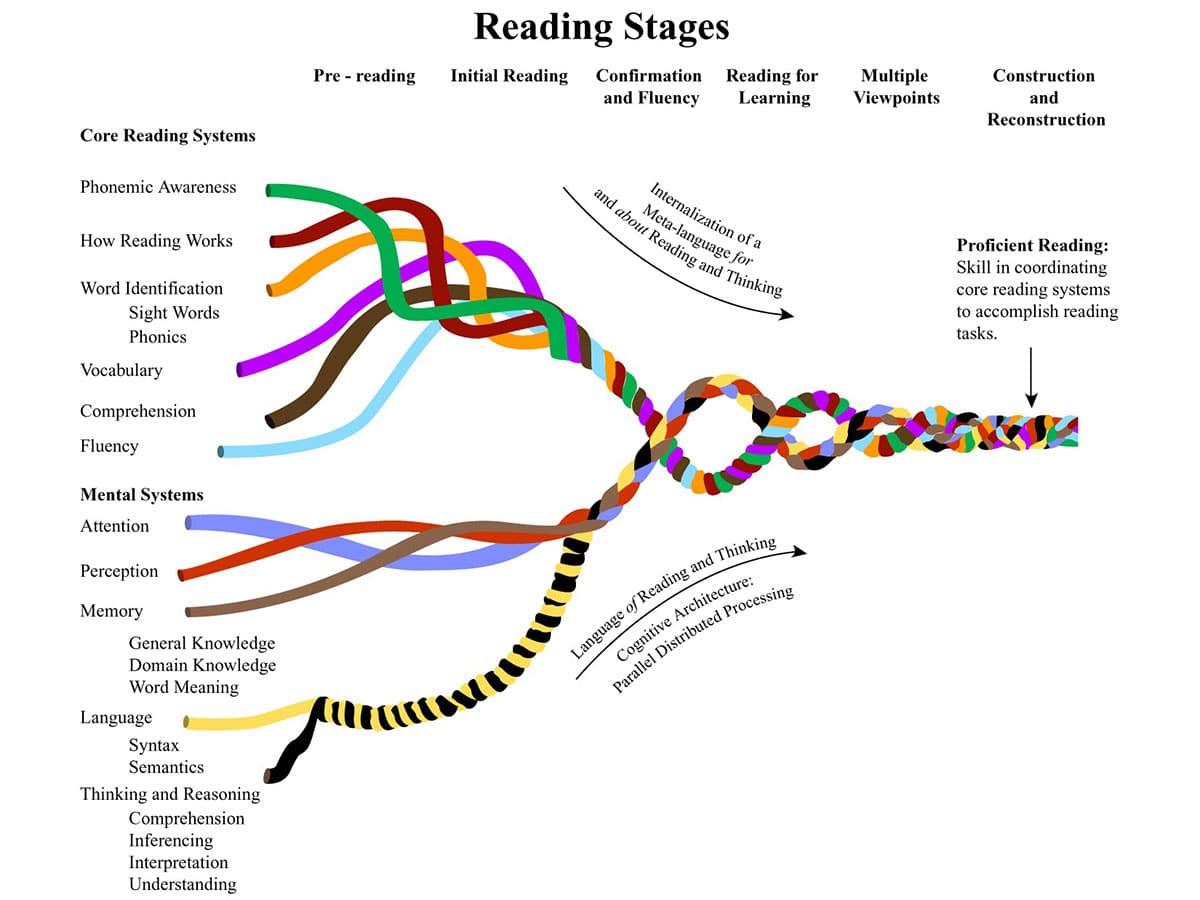
Language skills form a significant part of The Reading Rope and are crucial to the foundation of literacy development. These skills include:
- Speech – the ability to pronounce sounds correctly
- Phonological awareness – the ability to break up and blend sounds and syllables in words (e.g. the sounds in dog = d – o – g, the syllables in elephant = el – e – phant), rhyming skills and segmenting sounds in words
- Vocabulary – understanding and using a variety of words correctly, and understanding the semantic links (relationships) between words
- Comprehension — the ability to understand, follow and process what is said / read
- Narrative skills – the ability to understand and tell a story
- Grammar (syntax) – the ability to understand and talk in grammatically correct sentences
- Inferencing – reasoning, problem solving and predicting what might happen based on the information that is available
Some children will develop these skills without trouble, while others may need additional support. Speech pathologists can identify and work with children who have early literacy difficulties and can provide intervention and support for older children experiencing learning difficulties.
Leave a Reply